
A Rare Vietnamese “Bleu de Hué” Water Pipe to Be Offered at Auction in Cannes

On June 24, 2026, Cannes Enchères will present, with the expertise of Gauchet Art Asiatique, a rare Vietnamese “Bleu de Hué” porcelain water pipe, estimated at €10,000–15,000.
The object combines several characteristics rarely preserved together: a specifically Vietnamese typology, high quality porcelain produced for the imperial Vietnamese market, a dragon decoration associated with the power symbols of the Nguyễn dynasty, and an important original metal mounting preserved complete.
“Bleus de Hué”, Imperial Vietnamese Porcelain Ordered from China
The piece belongs to the group of porcelains now known as “Bleus de Hué”, a term used to describe blue and white porcelains commissioned by the Vietnamese imperial court from Chinese kilns, mainly those of Jingdezhen in Jiangxi province.
The term therefore does not refer to a specific Vietnamese manufacture but rather to a group of productions made in China to satisfy the tastes and ceremonial needs of the Nguyễn court.
The name “Bleu de Hué” naturally derives from Huế, the imperial capital of the Nguyễn dynasty from the early nineteenth century onward. These porcelains were intended for the emperor, the imperial family, mandarins, and the great Vietnamese aristocratic families. They occupied an essential place within court culture: table services, scholar’s objects, altar garnitures, incense burners, ritual cups, and refined daily objects such as this water pipe.
In Vietnam, these porcelains are often referred to as “đồ sứ ký kiểu”, a term that may be translated as “porcelain made to order according to a specific model”. The Vietnamese court sent extremely precise instructions to Chinese workshops regarding forms, imperial dragons, inscriptions, poems, and motifs adapted to Vietnamese usage.
These objects therefore differ significantly from porcelains produced either for the European export market or for domestic Chinese consumption.
Jingdezhen and the Technical Mastery Behind Imperial Porcelain
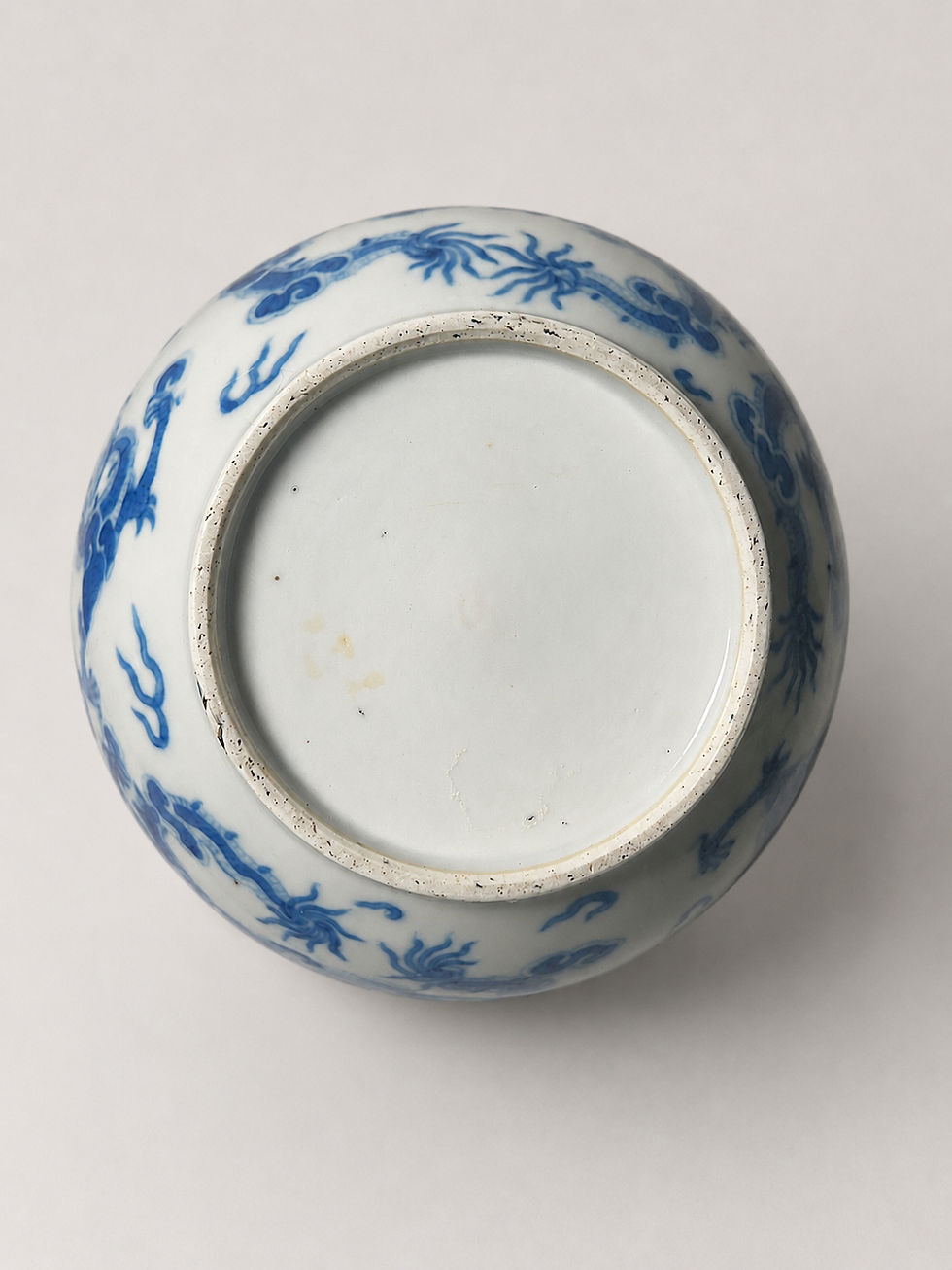
One of the most remarkable aspects of this water pipe remains the exceptional quality of its porcelain. The purity of the white body, its translucency, the precision of the decoration, and especially the depth of the underglaze cobalt blue all point toward the finest Chinese kilns working for the Vietnamese market.
This exceptional quality largely relied on the use of kaolin, an extremely pure white clay employed in the Jingdezhen kilns for centuries. Mixed with locally sourced porcelain stone, a finely ground feldspathic rock, the kaolin allowed potters to achieve a body that was particularly white, fine, and resistant after firing at very high temperatures.
This technical mastery is precisely what established Jingdezhen’s worldwide reputation, earning it the nickname “the porcelain capital”.
The finest Jingdezhen workshops succeeded in producing porcelains of extraordinary whiteness and translucency, perfectly suited to blue and white underglaze cobalt decoration. The depth and clarity of the blue depended directly on pigment quality, firing control, and the exceptional purity of the porcelain body itself.
By contrast, locally produced Vietnamese wares, especially those from Bát Tràng near Hanoi or workshops around Huế, generally display more ivory toned bodies, thicker glazes, and less refined drawing.
This difference explains why Vietnamese elites continued to commission their finest porcelains from China rather than relying solely on local production.
A Production Linked to the Rise of the Nguyễn Dynasty
The development of Bleu de Hué porcelains accelerated from the late eighteenth century onward and especially under the Nguyễn dynasty, following the accession of Gia Long in 1802.
Under Gia Long and later Minh Mạng, the imperial court sought to affirm its prestige through luxurious commissions inspired by Chinese imperial models while retaining distinctly Vietnamese characteristics.
Although this water pipe bears no reign mark, its style, dragon decoration, and porcelain quality firmly associate it with Nguyễn taste productions made for privileged circles during the nineteenth century.
Recent research has also shown that these imperial commissions circulated through major maritime trade networks linking southern China to Vietnamese ports. Hội An notably played an essential role in these exchanges before Huế gradually concentrated the circuits connected to the imperial court.
A Distinctively Vietnamese Form

While China developed many types of smoking utensils, the porcelain mounted water pipe remained particularly characteristic of Vietnam.
Western travelers of the nineteenth century frequently described their widespread use among Vietnamese scholar and mandarin circles. The porcelain body served as a water reservoir, while tobacco was placed in a small metal bowl and lit using hot embers. Smoke then passed through the water before being inhaled through a tube, often made of bamboo.
The water cooled and filtered the smoke, producing a distinctive bubbling sound often mentioned in colonial era accounts of traditional Vietnamese interiors.
These pipes were primarily intended for tobacco consumption. Although opium also appeared in nineteenth century Vietnam through regional trade and growing Chinese influence, this particular type of water pipe remained fundamentally associated with Vietnamese tobacco use.
Their use was strongly connected to male scholarly sociability. Such pipes accompanied gatherings of mandarins, learned conversations, and moments of reception. They formed part of a larger group of objects including tobacco boxes, trays, ember tools, and accessories linked to betel consumption.
A Growing Market
Bleu de Hué water pipes remain rare on the Western market, particularly early examples preserved with their complete original metal mountings.
In recent years, interest from Vietnamese and international collectors in objects connected to the Nguyễn imperial court and nineteenth century Sino Vietnamese commissions has increased considerably.
Gauchet Art Asiatique had previously presented with Cannes Enchères a comparable Bleu de Hué water pipe, highlighted by La Gazette Drouot and sold for €63,500 in December 2024, confirming the growing market interest in authentic Bleu de Hué porcelains and Vietnamese imperial decorative arts


Comments