Henri Mège (1904-1984) Estimate: Price, value, and sale of his Vietnam paintings

Owning a painting by Henri Mège can reveal far more than a simple exotic landscape. His oil paintings of Vietnam, its rice paddies, junks, misty bays, and the rivers of Hue occupy a unique place in the 20th-century Vietnamese art market. They combine the vision of a French painter, an intimate knowledge of the country, and a rare sensitivity to the light of Indochina.
Gauchet Art Asiatique assists collectors, families, and owners with the appraisal, evaluation, documentary authentication, and sale of paintings by Henri Mège. Their rigorous expertise allows them to distinguish the most desirable Indochinese landscapes, often created between the 1930s and 1950s, from later Savoyard works, small decorative pieces, and works on paper.
Henri Mège, a French painter deeply connected to Vietnam
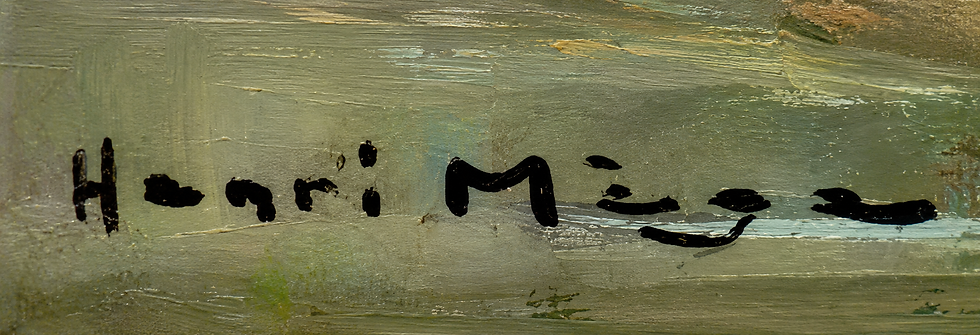
Henri Mège was born in Romans-sur-Isère in 1904. He discovered painting at a very young age through his mother, the artist Isabelle Mège, whose work sessions and museum visits nourished his learning. This sensitive training, largely based on direct observation, undoubtedly explains his freedom of brushstroke and his constant attention to light.
After his studies, Henri Mège initially chose a military career. He left for Indochina in 1931, a stay that would definitively transform both his life and his painting. Settled in Hue, he frequented the circles of the imperial court and became close to Emperor Bảo Đại. He became an equerry and then commander of the imperial guard, a position that gave him exceptional knowledge of the landscapes, customs, and elites of Vietnam at the time.
During these years, Henri Mège developed close ties with the local art world. He became particularly close to Mai Trung Thứ, known as Mai Thu, then a young Vietnamese painter destined to become one of the leading figures of modern Vietnamese art. His marriage to the great-niece of the last Viceroy of Tonkin further strengthened this personal and familial connection to Vietnamese society.
His career was interrupted by his imprisonment during the Japanese invasion of 1940. However, he continued his artistic and teaching activities after the war, becoming a professor at the Saigon School of Fine Arts between 1950 and 1956. This twenty-five-year period in Indochina constitutes the heart of his artistic identity.
Upon returning to France, Henri Mège settled in Chambéry. He painted there until his death in 1984. His Savoyard landscapes retain a peaceful and luminous atmosphere, but it is his Vietnamese works that now attract the majority of the interest of international collectors.
Henri Mège and the Indochina School of Fine Arts: a unique position
Henri Mège should not be confused with students of the Indochina School of Fine Arts in Hanoi, such as Lê Phổ, Mai Trung Thứ, Vũ Cao Đàm or Nguyễn Gia Trí. His path is different.
He belongs to a generation of French painters who lived, worked, and taught in Indochina. His importance lies in his direct knowledge of Vietnam, his connections with Vietnamese artists, and his role as a professor in Saigon. This close relationship explains the prominent place of his works in specialized sales dedicated to 20th-century Vietnamese art.
His paintings are not visions of distant travel. They result from a long, personal, and daily experience of the country. Hue, the Perfume River, Halong Bay, Tonkin, Thanh Hoa, the rice paddies of Annam, and the villages of central Vietnam constitute the major landmarks of his work.
The most sought-after subjects in Henri Mège's paintings

The most highly valued works are generally Vietnamese landscapes with clearly defined locations, titles, or countersigns on the reverse. These inscriptions often constitute an essential element for understanding, attributing, and appraising the painting.
Collectors are particularly interested in compositions depicting:
Hue and its surroundings, including the rivers, lagoons and villages
Halong Bay and the landscapes of limestone karsts
Junks, boats and fishing scenes
Rice paddies, rural paths and silhouettes of villagers
The highlands and landscapes of Tonkin
The views of Thanh Hoa, Quang Tri, Nha Trang or the delta
Scenes of spring, morning, misty, or winter light
The quality of light is central to his work. Henri Mège often uses a generous palette, deep greens, luminous grays, and subtle reflections of water. His landscapes combine a solid Western structure with a more meditative atmosphere, akin to the sensory experience of Asian landscapes.
The value of Henri Mège's painting: how much is it worth today?
Henri Mège's market value has increased with the renewed interest in painters associated with Vietnam and former Indochina. However, it remains selective. Prices vary considerably depending on the subject matter, period, dimensions, condition, provenance, and the quality of the information on the reverse.
The best works are those that combine a strong Vietnamese subject, a high-quality format, an ambitious composition, and a precise location. Landscapes of Hue, Halong Bay, Vietnamese rivers, or rice paddies can reach the highest market prices.
Work category | Indicative hammer price range |
Drawings, watercolors, lithographs and small works on paper | €300 to €1,500 |
Small Indochinese landscapes on panel, formats less than 30 cm | €1,000 to €3,500 |
Medium-sized Vietnamese landscapes, well-titled or with specific locations | €3,500 to €7,000 |
Important oils from Hue, Halong, Thanh Hoa or the rice paddies | €7,000 to €10,000 |
Particularly powerful, rare, historical works, or works with remarkable provenance | estimate based on study |
These price ranges are indicative and do not replace an expert appraisal. A small panel work may exceed the value of a larger canvas if its title, date, location, or subject matter are particularly appealing.
Significant sales results for Henri Mège
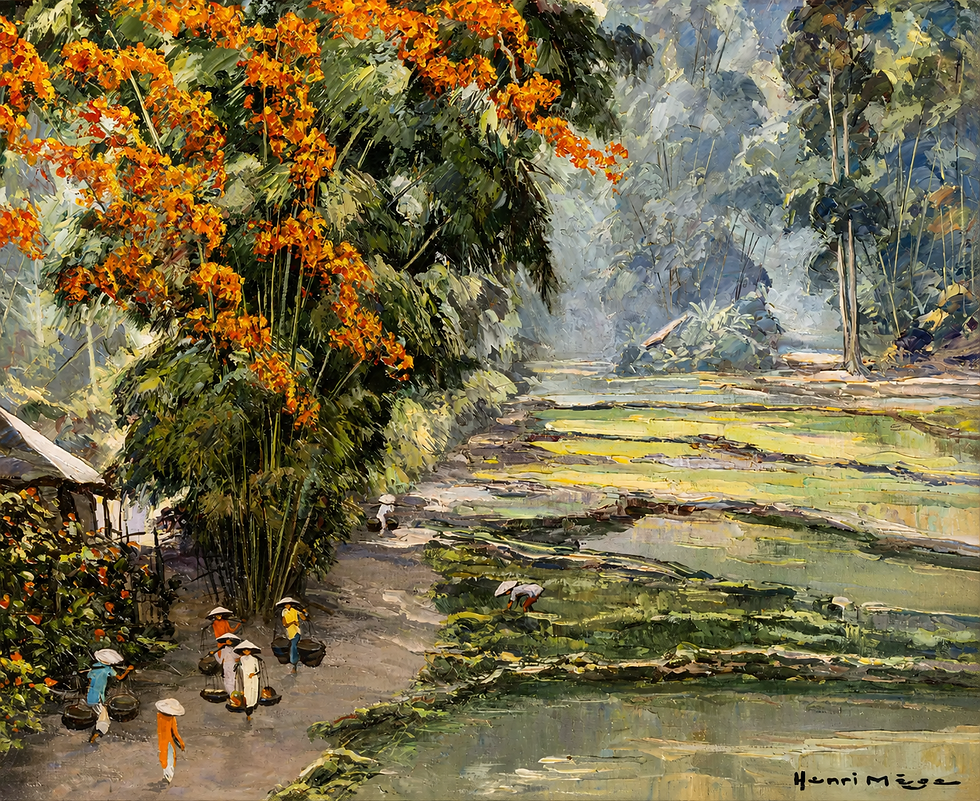
Recent market trends confirm the growing interest of collectors in Henri Mège's Vietnamese paintings. When presented in specialized sales devoted to Vietnamese art, Indochinese painting, or artists associated with former French Indochina, his works can significantly exceed their estimates. Landscapes of Hue, Halong Bay, Thanh Hoa, and the rice paddies and rivers of Vietnam are currently the most sought-after, particularly when they are large-format oil paintings on canvas or panel, signed, and accompanied by a title, location, or countersignature on the reverse.
Artwork | Technical specifications and dimensions | Hammer result |
Winter morning in Halong Bay | Oil on panel, 49 x 72 cm | €10,000 |
Spring morning near Hue | Oil on canvas, 50 x 61 cm | €10,000 |
Morning in the highlands | Oil on canvas, 46 x 55 cm | €9,000 |
The Thanh Hoa River | Oil on panel, 37 x 79 cm | €7,500 |
Bouquet of flowers | Oil on canvas, 50 x 61.5 cm | €7,000 |
Morning in villages near Hue-Annam | Oil on canvas | €6,200 |
Landscape of the highlands of northern Vietnam | Oil on canvas | €5,000 |

These results confirm a clear hierarchy. Vietnamese landscapes of medium or large format, particularly those linked to Hue, Halong and the rivers of Indochina, constitute the most sought-after segment of Henri Mège's production.
The Savoyard works, the unlocalized landscapes, the late small-format pieces, and the works on paper are generally more accessible. Their interest remains real, but they do not enjoy the same international demand as the Vietnamese landscapes.
How to value a painting by Henri Mège?

The valuation of a painting by Henri Mège is not based solely on his signature. A complete appraisal must examine the work as a whole.
The first step is to identify the support. Oils on canvas and oils on panel are the most common. Older panels sometimes retain titles, dates, locations, numbers, or a second signature on the reverse. These inscriptions can be crucial.
The second step concerns the subject. A work titled Hue , Halong Bay , Thanh Hoa , Annam , Tonkin or Saigon has a documentary and commercial force superior to a simple Landscape or River .
The state of preservation must also be carefully analyzed. Restorations, repainting, lifting of material, panel damage, changes in format or yellowing varnish can significantly alter the value.
Finally, provenance plays an essential role. A work preserved in a family linked to Indochina, accompanied by archives, old labels, photographs or documented family transmission, deserves special attention.
Selling a painting by Henri Mège under the best conditions
When selling a work by Henri Mège, the choice of sales channel is crucial. A quality Vietnamese painting should not be lost in a general sale of modern or regional paintings.
The best results are generally achieved in sales dedicated to Asian art, Vietnamese art, Indochinese painters, or artists associated with the Saigon and Hanoi Schools of Fine Arts. These sales attract French, Vietnamese, and international collectors who appreciate the historical significance of the subject.
The sales strategy should include:
A professional photograph faithful to the colors and texture
A clear view of the signature
Photographs of the reverse side, inscriptions, and any labels
A rigorous biographical note
A French and Vietnamese translation is required when the sale targets the Asian market.
An estimate consistent with recent results
A presentation in a targeted session, rather than a general sale
A beautiful work by Henri Mège must be defended as a major pictorial testimony of 20th century Vietnam, and not as a mere decorative landscape.
Why use Gauchet Art Asiatique for a Henri Mège appraisal?
Gauchet Art Asiatique assists owners of Vietnamese paintings and works related to Indochina in all stages of their project: signature study, subject analysis, examination of inscriptions on the reverse, search for comparable works, market evaluation and sales strategy.
Our approach is based on knowledge of the Vietnamese art market, international sales, and the criteria sought by collectors. An initial estimate can be made using photographs of the front and back, the signature, dimensions, and any available provenance documents.
For a work by Henri Mège, every detail counts. A simple title on the reverse, a precise location, or a former Indochinese provenance can significantly alter the value and guide the best sales strategy.
Frequently Asked Questions about Henri Mège
How much is a painting by Henri Mège worth?
Prices can range from a few hundred euros for certain works on paper or small secondary landscapes to €10,000 and more for important Vietnamese oils, well preserved and presented in specialist sales.
Which paintings by Henri Mège are the most sought after?
Landscapes of Hue, Halong Bay, rice paddies, Vietnamese rivers and highlands are the most in demand, especially when titled, located and signed on the reverse.
Do Henri Mège's Savoy landscapes have the same value?
No. They have real artistic merit, but the international market generally favors works related to Vietnam and Indochina.
How to recognize an authentic painting by Henri Mège?
The signature must be studied in conjunction with the support, the brushstroke, the composition, any title on the reverse, the dimensions, any old labels, and the provenance. A signature alone is never sufficient to guarantee authenticity.
How to get a work by Henri Mège appraised?
Send us a clear photograph of the entire work, a view of the back, a close-up of the signature, the exact dimensions and any information about its provenance for an initial analysis.
Get an appraisal or sell a painting by Henri Mège

Do you own a Vietnamese landscape, a view of Hue, a rice paddy scene, a painting of Halong Bay or a work signed Henri Mège?
Gauchet Art Asiatique assists you with the estimation, evaluation, analysis of inscriptions, preparation of a sales file and the choice of the auction house best suited to your work.


This was a very engaging and insightful post that provided valuable guidance for students facing academic challenges. I really liked how the author explained the topic in a simple and practical way, making it easy to understand. As a university student, I often read educational blogs like this to improve my knowledge and stay motivated. During demanding semesters, many learners also search for assignment help to better manage deadlines and understand complex topics. Posts like this offer practical insights, encourage effective study habits, and help students stay confident throughout their academic journey.