Tran Phuc Duyen (1923-1993): "In the Rice Paddy," a masterpiece of modern Vietnamese lacquer

A master from the School of Fine Arts of Indochina
Among the great names of 20th-century Vietnamese art, Tran Phuc Duyen (1923-1993) occupies a unique place. Trained at the Indochina School of Fine Arts in Hanoi, which he entered in 1942 before obtaining his diploma in 1946 with a specialization in lacquer, he belongs to that generation of artists who transformed a traditional craft technique into a major medium of Asian modernity.
Alongside Nguyen Gia Tri, Le Quoc Loc, Pham Hau, and Nguyen Khang, he contributed to the emergence of a true Vietnamese school of lacquer. His work is distinguished by exceptional technical mastery and a profoundly poetic vision of the Vietnamese landscape.
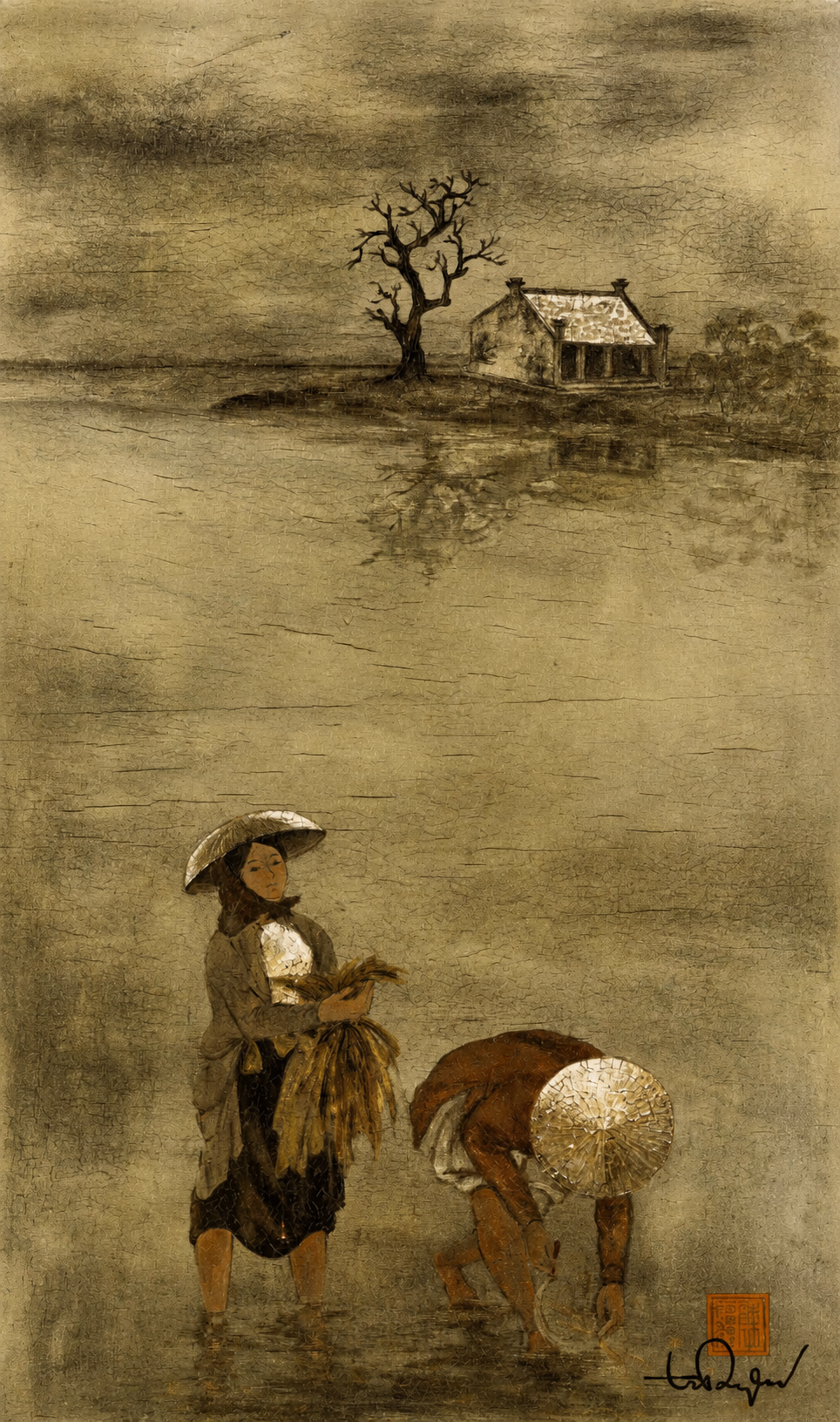
The work presented here, Dans la rizière (In the Rice Paddy ), belongs to the most sought-after period of his career, created before his departure for France in 1954.
In the rice paddy: a timeless vision of rural Vietnam
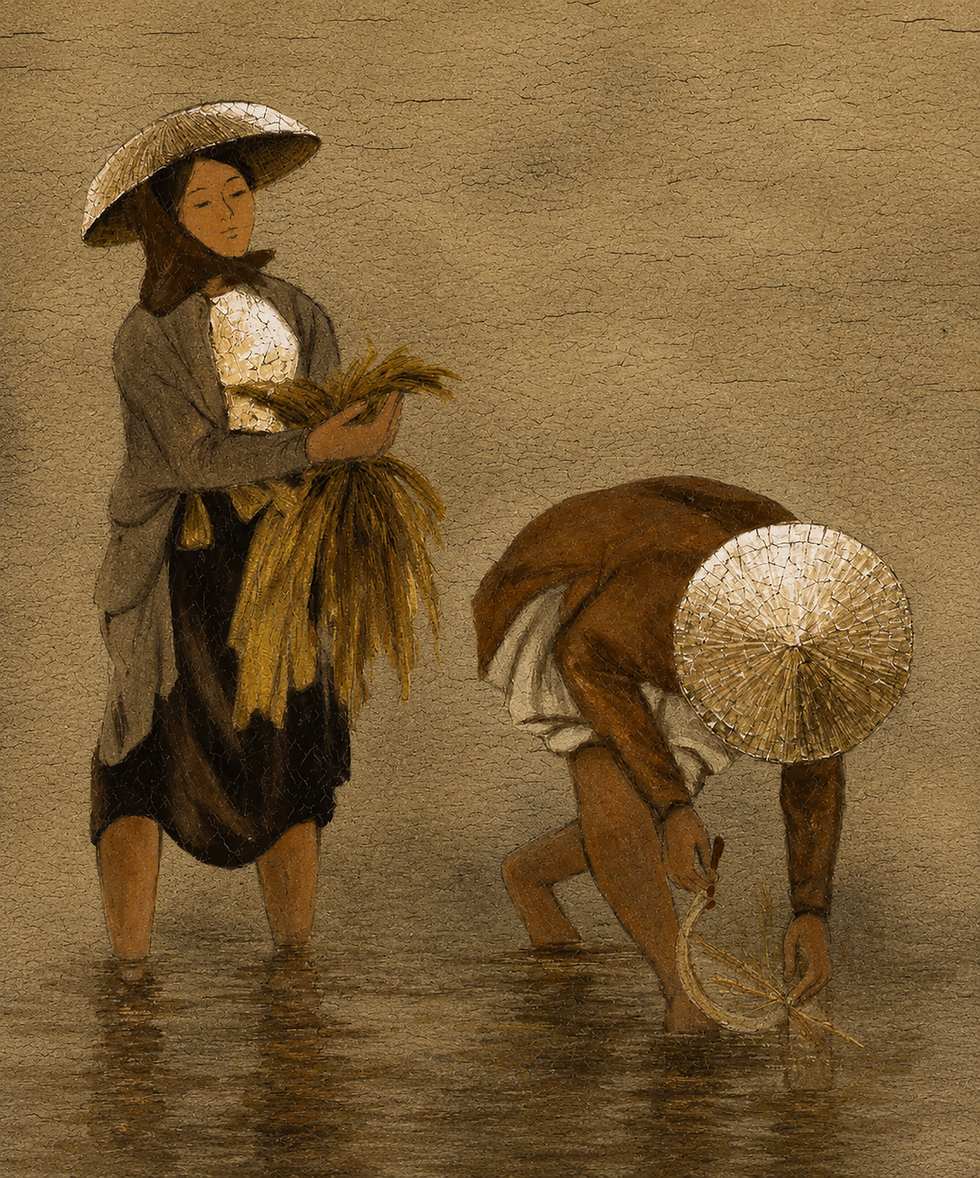
This polychrome lacquered wooden panel, measuring 50 x 29.5 cm, depicts two peasant women working in a flooded rice paddy.
One woman holds a sheaf of freshly harvested rice in her arms, while her companion bends towards the water in a routine gesture. In the background, a traditional Vietnamese house and a solitary tree appear, their silhouettes reflected in the calm surface of the rice paddy.
The composition is immediately striking in its simplicity. The artist deliberately reduces the narrative elements in order to focus attention on the overall atmosphere of the scene.
Water, sky, and earth seem to merge into a single luminous substance. The figures become almost secondary in the face of the silent immensity of the landscape.
This ability to transform an ordinary rural scene into a universal image is one of Tran Phuc Duyen's most recognizable signatures.
The Vietnamese lacquer revolution
The School of Fine Arts of Indochina was at the origin of a true artistic revolution.
Before the 1930s, lacquer was mainly used for furniture, religious objects, or decorative arts. Under the influence of French professors and Vietnamese artists, it gradually became a fully-fledged pictorial medium.
Tran Phuc Duyen has mastered this complex technique based on the layering of successive layers of natural resin, pigments, metallic leaves, sometimes enriched with mother-of-pearl or eggshell.
The layers are then sanded and polished to gradually reveal the different depths of material.
In In the Rice Paddy , this technique allows for particularly subtle lighting effects. The golden tones, the reflections in the water, and the atmospheric variations demonstrate exceptional technical virtuosity.
The Vietnamese period: the peak of its production

Collectors today clearly distinguish between works created before 1954 and those produced after his move to Europe.
The Vietnamese period corresponds to a time when the artist drew his inspiration directly from the landscapes, villages and daily life of his native country.
Rice paddies, temples, lakeside villages and rural scenes became the main subjects of his work.
It is precisely to this period that Dans la rizière , now particularly sought after on the international market, relates.
A rapidly improving rating
Long overshadowed by artists such as Le Pho, Mai Trung Thu or Vu Cao Dam, Tran Phuc Duyen has been experiencing a spectacular re-evaluation for several years.
This progression is based on several factors: the scarcity of important works, the growing interest in the Indochina School of Fine Arts, and the rediscovery of the fundamental role played by Vietnamese lacquer in the history of modern Asian art.
Public auction results perfectly illustrate this trend.

Lacquered coffee table decorated with goldfish
Sold for €22,000
This elegant decorative creation demonstrates that the market is also interested in the artist's furniture designs.

View of the Ngoc Son temple on Hoan Kiem Lake, 1951
Sold for €77,000
This remarkable view of one of Hanoi's most famous monuments illustrates Tran Phuc Duyen's fascination with Vietnam's historical landscapes.

The Thay Pagoda
Sold for €80,000
This architectural landscape executed on a gold background represents one of the most iconic Buddhist sanctuaries in northern Vietnam.

Riverbanks, 1950
Sold for €290,000
This spectacular eight-panel screen is now one of the artist's most important works. Made of polychrome lacquer enriched with gold, mother-of-pearl and eggshell inlays, it depicts a vast Vietnamese tropical landscape of exceptional quality.
Why are Tran Phuc Duyen's works sought after?
Several factors explain the current enthusiasm of collectors.
First, the exceptional quality of his training at the École des Beaux-Arts de l'Indochine. Second, the rarity of important works held in private collections. Finally, the uniqueness of his artistic language, capable of combining Western modernity and Vietnamese traditions.
Its landscapes also possess a historical dimension. They bear witness to a Vietnam that has largely disappeared today, preserved through an idealized but profoundly sincere vision.
What is the value of a work by Tran Phuc Duyen?
The observed auction results allow us to establish the following price ranges:
Furniture and decorative objects: €10,000 to €30,000
Small figurative panels: €20,000 to €60,000
High-quality landscapes and rural scenes: €50,000 to €120,000
Large decorative compositions: €100,000 to €250,000
Monumental screens and major works: €250,000 to over €1,000,000
Works from the Vietnamese period remain the most sought after, particularly when they depict rural landscapes, rice paddy scenes, traditional villages, or iconic monuments of Hanoi.
Expertise and estimation of Tran Phuc Duyen
The precise identification of signatures, stamps, manufacturing techniques and provenances is now essential to determine the value of a work by Tran Phuc Duyen.
Specializing in modern Vietnamese art and the Indochina School of Fine Arts, Gauchet Art Asiatique assists collectors, heirs, institutions and auction houses in the expertise, authentication and valuation of works by Tran Phuc Duyen as well as the great Vietnamese masters of the 20th century.
Our research is based on the study of signatures, seals, lacquer techniques, archives, provenances and the most recent international market results.
For a confidential appraisal or valuation of a work by Tran Phuc Duyen, Nguyen Gia Tri, Le Quoc Loc, Pham Hau, Nguyen Khang, Le Pho, Mai Trung Thu or Vu Cao Dam, contact Gauchet Art Asiatique directly.
Gauchet Art Asiatique is today one of the French firms specializing in the expertise of modern Vietnamese art, Vietnamese lacquer and artists from the École des Beaux-Arts de l'Indochine.


Comments