Nguyen Tuong Lan (1906-1946) and The Bathers: a major work of the Indochina School of Fine Arts.

A major rediscovery of the Indochina School of Fine Arts

In 2025, Gauchet Art Asiatique had the privilege of appraising an exceptional work by Nguyen Tuong Lan (1906-1946), one of the most important artists of the first generation of the École des Beaux-Arts de l'Indochine.
Entitled "The Bathers" and created around 1935, this delicate ink and color composition on silk depicts two young women in a lush tropical landscape. The softness of the tones, the subtlety of the modeling, and the poetic atmosphere emanating from the scene perfectly illustrate the artistic synthesis developed by the great Vietnamese masters trained in Hanoi during the colonial period.
After expert appraisal, we advised our client to present the artwork at a specialized auction organized by MILLON. Estimated at between 30,000 and 40,000 euros, it ultimately sold for 310,000 euros, confirming the extraordinary growth of the Vietnamese art market.
A work exhibited since 1936

One of the most remarkable aspects of this painting lies in its exhibition history.
Research conducted in the INHA archives made it possible to identify the work in an exhibition organised by SADEAI (Société Annamite d'Encouragement à l'Art et à l'Industrie) in 1936.
This institution played a fundamental role in promoting the emerging Vietnamese modern art scene and brought together the colony's most promising artists. The presence of the Bathers in this exhibition constitutes a rare historical record, particularly valuable for collectors.
Few Vietnamese works from this period today benefit from such clearly documented provenance and exhibition history.
Who was Nguyen Tuong Lan?

Born in 1906, Nguyen Tuong Lan belongs to the founding generation of the École des Beaux-Arts de l'Indochine, created by Victor Tardieu and Joseph Inguimberty in Hanoi in 1925.
He is among the most talented artists of his graduating class alongside Le Pho, Mai Trung Thu, Vu Cao Dam and Nguyen Phan Chanh.
Unlike many of his contemporaries who settled in France, Nguyen Tuong Lan remained mainly in Vietnam where he developed a deeply personal pictorial language.
His career was unfortunately short, as he died in 1946 at only forty years old.
This early death largely explains the rarity of his works on the international market.
A rare artist whose value continues to rise
Nguyen Tuong Lan now belongs to the very select circle of historical Vietnamese artists whose important works regularly fetch between €100,000 and €300,000 , while major masterpieces can reach or exceed €400,000 . His output being much rarer than that of Lê Phổ or Mai Trung Thứ, each significant appearance on the market attracts the attention of collectors from Vietnam, Hong Kong, Singapore, and Europe.

This progression is illustrated by two major results. In 2014, At the Pagoda (circa 1935), from the prestigious Tholance-Lorenzi collection and acquired directly from the artist, was sold at Christie's Hong Kong for 1.3 million HKD , or about 150,000 € .
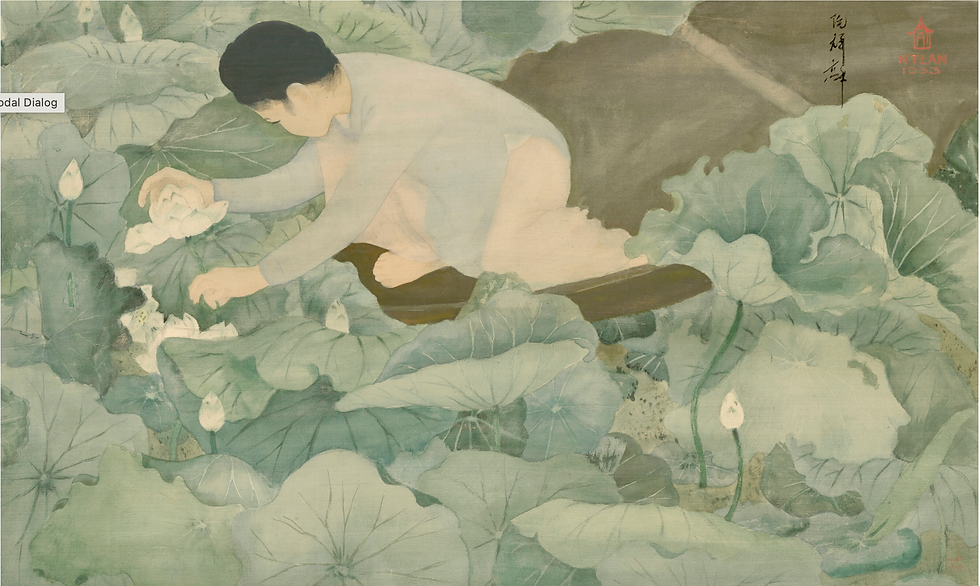
Ten years later, the market reached a new milestone with In the Lotuses (1933), one of the artist's most iconic works. Presented at Christie's Hong Kong in 2024, this important silk composition exceeded HKD 3.1 million , or nearly USD 400,000 , confirming the soaring value of major works by Nguyen Tuong Lan.
In this context, the sale of Les Baigneuses for €310,000 appears particularly fitting. Created around 1935, exhibited at the SADEAI as early as 1936, and held in a South American private collection, the work met all the criteria sought by collectors: rarity, museum quality, emblematic subject matter, and a well-documented exhibition history. Its result confirms that Nguyen Tuong Lan now belongs to the group of the most sought-after Vietnamese artists of the 20th century, alongside Lê Phổ, Mai Trung Thứ, Vũ Cao Đàm, and Nguyễn Phan Chánh.
Nguyen Tuong Lan's artistic influences
Nguyen Tuong Lan occupies a unique position in the history of Vietnamese art.
Trained according to French academic methods, he also draws inspiration from traditional Chinese painting and Japanese aesthetics.
His work is distinguished by a constant search for harmony between Western modernity and Asian sensibility.
In The Bathers , this synthesis appears with great clarity.
The composition is reminiscent of certain early 20th-century European models, while the treatment of the figures, the economy of drawing, and the delicacy of the colors remain profoundly Asian.
This ability to fuse several traditions is one of the essential characteristics of the great masters of the Indochina School of Fine Arts.
Why The Bathers is an important work
Several factors explain the exceptional interest aroused by this painting.
First, the subject itself.
Representations of nudes remain relatively rare in Vietnamese art of this period and testify to the gradual introduction of Western academic teachings into local creation.
Next, the pictorial quality.
The work possesses an almost dreamlike atmosphere where the figures seem to blend into the tropical vegetation.
Finally, its history of exposure at SADEAI gives it considerable documentary importance.
Bringing together in a single work artistic quality, rarity, provenance and exhibition history is a combination particularly sought after by international collectors.
The spectacular rise of the Vietnamese art market
The success of the Bathers is part of a larger phenomenon.
For the past twenty years, Vietnamese historical artists have experienced a spectacular increase in their results.
Le Pho, Mai Trung Thu, Vu Cao Dam, Nguyen Phan Chanh and Nguyen Tuong Lan are now present in the largest private and institutional collections in Asia.
This development is driven in particular by the emergence of a new generation of Vietnamese collectors eager to find masterpieces scattered around the world during the 20th century.
The most important works are now being contested by buyers from Vietnam, Hong Kong, Singapore, France and the United States.
Expertise and appraisal of Vietnamese artworks

The example of the Bathers demonstrates the importance of a specialized expertise before any sale.
Accurate identification of the artist, provenance research, archival research, and selection of the appropriate sales strategy can have a considerable impact on the final result.
Gauchet Art Asiatique assists collectors, heirs and professionals with the expertise, appraisal and valuation of modern Vietnamese works, whether they are paintings from the École des Beaux-Arts de l'Indochine, lacquers, silks or drawings.
Do you own a work by Nguyen Tuong Lan, Le Pho, Mai Trung Thu, Vu Cao Dam or another Vietnamese artist? Our firm conducts confidential appraisals in France and internationally.


Comments