The "Magots" of Canton: the fascinating dignitaries with movable heads who captivated Europe

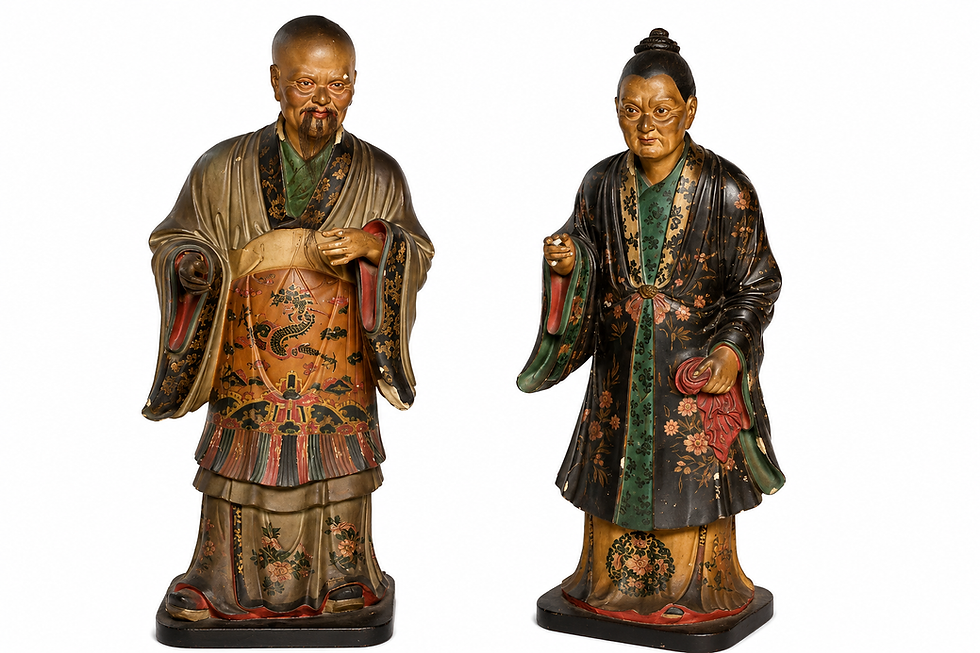
Among the most singular creations of Chinese export art, few objects embody the encounter between East and West as perfectly as the famous "magots" of Canton. Produced in the late 18th and early 19th centuries for European and American markets, these polychrome sculptures with movable heads were long considered one of the most refined expressions of the taste for China.
The remarkable pair presented here, representing a couple of Chinese dignitaries, illustrates the pinnacle of this production. Made of polychrome stucco, retaining their removable heads and reaching over 70 cm in height, these figures belong to the most prestigious and rarest category of Cantonese "nodders".
A China imagined for European trade shows
In the 18th century, Europe's fascination with the Middle Kingdom reached its peak. Shipments from the East India Companies brought back porcelain, lacquerware, silks, furniture, and curiosities destined for aristocratic residences.
The workshops of Canton then developed a production specifically designed for Western tastes. Among the most spectacular objects were these figures of mandarins, sages and Chinese dignitaries, whose appearance perfectly corresponded to the exotic image that Europe then had of China.
These sculptures were intended to be displayed in the drawing rooms, cabinets of curiosities and decorative galleries of grand English, French, Dutch or American homes.
The secret of the "nodders"

The most remarkable feature of these figures lies in their ingenious internal mechanism.
The head, independent of the body, rests on a wooden or bamboo axis weighted at its base. The slightest movement then causes a slight swaying, giving the impression that the figure is agreeing.
This characteristic quickly earned them their English name of "nodders", literally "those who nod their heads".
The process, both simple and ingenious, contributed greatly to their success with European collectors who sought both the decorative effect and the fun and spectacular nature of these works.
A remarkable couple of dignitaries
The male figure wears a long formal robe adorned with an imposing central breastplate inspired by Qing dynasty court attire. His beard, crafted from natural black horsehair, further enhances the character's realism.
The female figure, meanwhile, sports an elegant black coat decorated with flowers painted on a green background, while her updo evokes the Manchu fashions of the time.
The faces, carefully modeled and individualized, demonstrate a genuine concern for naturalism rarely seen in decorative productions intended for export.
With their respective dimensions of 71.6 cm and 70.8 cm, these sculptures belong to the monumental models, much rarer than the medium-sized examples generally found on the market.
Objects already present in European royal collections

The antiquity and prestige of these figures are attested by an exceptional document.
As early as the 1760s, two large Chinese figures with movable heads appeared in the famous portrait of Queen Charlotte by Johan Zoffany. Now held in the British Royal Collection, this work demonstrates that these sculptures were already among the most prized objects in European aristocratic residences.
Their presence in an official portrait of the royal family testifies to the privileged status of these works, considered at the time as true symbols of oriental refinement.
Comparative examples preserved in museums
Several comparable examples are now preserved in major public collections.
The Victoria & Albert Museum in London has several similar export figures from China, illustrating the importance of this production in the history of artistic trade between China and the West.
These collections allow us to observe the evolution of techniques used in Cantonese workshops, including the use of unfired clay, stucco, complex polychromy, and the integration of natural hair or added textile elements.
The market's perspective

The market for Chinese Barbary macaques has seen a considerable resurgence of interest over the past two decades.
In June 2011, Christie's Amsterdam presented a comparable pair of movable-headed figures dating from the same period. Despite being significantly smaller—approximately 36 cm in height—this pair already confirmed collectors' interest in this type of object.
Other important examples have been offered at Christie's New York, notably in prestigious American collections devoted to Chinese export art.
The catalogues consistently highlight the rarity of large formats, with copies exceeding 70 cm being significantly less frequent than the more modest models produced in greater numbers.
A significant auction
Estimated at between €6,000 and €8,000, this pair was finally sold for €17,000, more than double its high estimate.
This result can be explained by several factors:
monumental dimensions;
preservation of the moving heads;
quality of the polychromy;
particularly vivid expressions;
documented private provenance;
scarcity of large models on the market.
This auction confirms the growing interest of collectors in major works of exported Chinese art, and more particularly in the great Cantonese "nodders" from the turn of the 18th and 19th centuries.
An exceptional testimony to the dialogue between China and the West
At the crossroads of sculpture, mechanical object and ceremonial decoration, these figures embody one of the most fascinating episodes in the history of the global art trade.
Produced in workshops in Canton to satisfy the tastes of European elites, they bear witness to a time when China exported not only objects, but also an idealized image of itself.
More than two centuries after their creation, these astonishing figures continue to fascinate with their presence, their technical inventiveness, and their ability to tell the story of exchanges between two worlds.
Expertise and appraisal of Chinese treasures with Gauchet Asian Art
Chinese magots, figures with movable heads produced in Canton for European export during the 18th and 19th centuries, are currently attracting increasing interest from collectors and the art market. Their value depends on numerous criteria: size, state of preservation, presence of original mechanisms, quality of polychromy, provenance, and rarity of the model. Specializing in Chinese art and export works from China, Gauchet Art Asiatique assists collectors, families, estates, and auction houses with the appraisal, authentication, and valuation of these historical sculptures. Our firm operates in France, Belgium, Switzerland, and internationally, evaluating porcelain, lacquerware, ivory, paintings, and other export objects from China, with valuations based on photographs or by appointment. To have a Chinese magot or any Asian artwork appraised, contact Gauchet Art Asiatique or use our online valuation service.


Comments